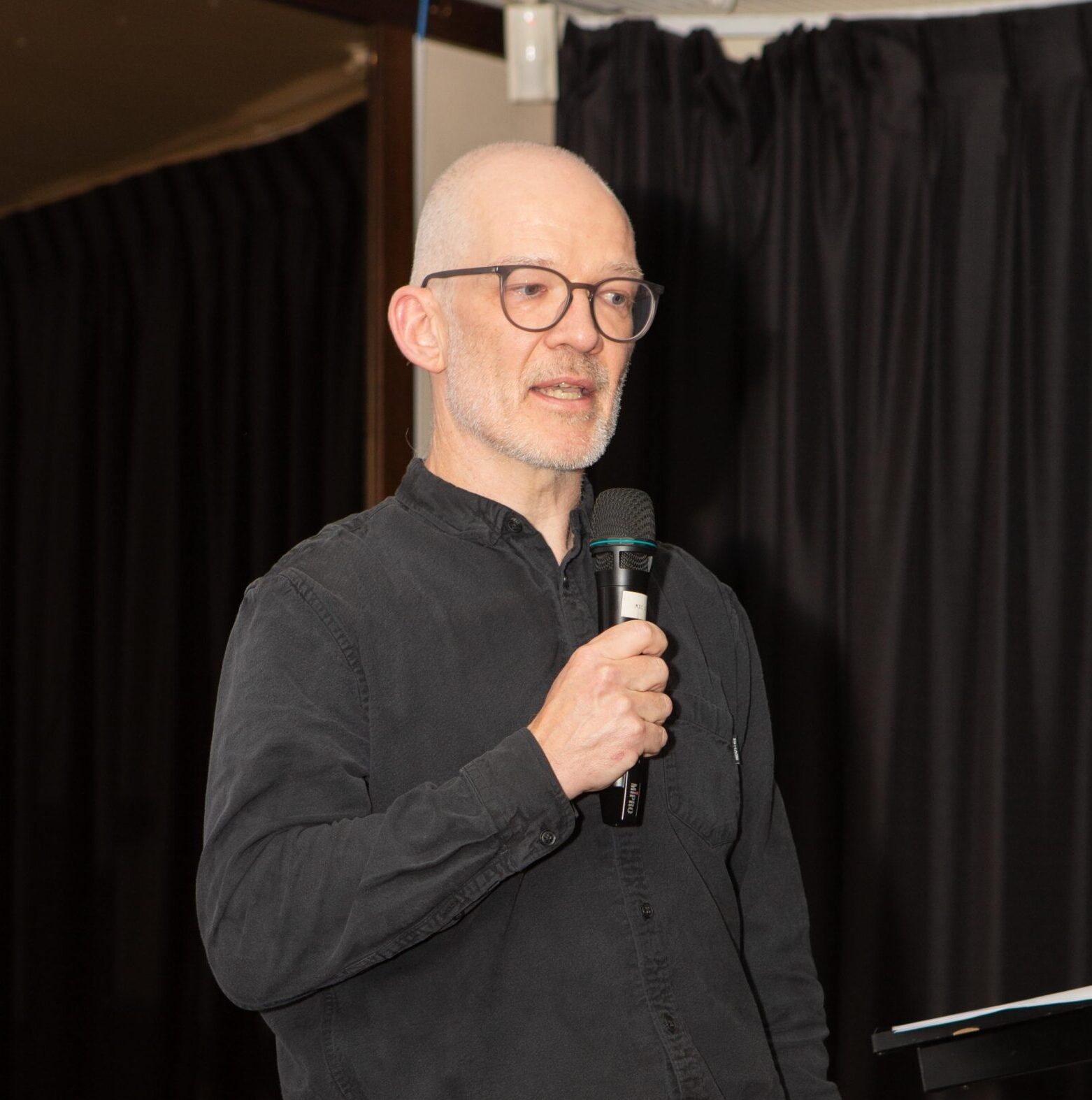
Stop Talking About Parking – Reflections from the Regional Mainstreet Forum, Waikerie
By Michael McKeown, Director, Jensen PLUS
Last month I presented at the Regional Mainstreet Forum in Waikerie, South Australia. The session gave me a chance to reflect on more than ten years of main street urban design projects - not just the design ideas and achievements, but what communities consistently tell us they think is needed in their main streets and town centres.
At Jensen PLUS, we have been fortunate to work on more than 25 main street and town centre projects over the past decade — in South Australia and interstate, and in many different regional settings. These projects have included streetscape designs, master plans, improvement strategies and more.
A lot to reflect on, and not just the designs.
For these projects, we usually start by engaging with businesses, communities, councils and other stakeholders. We need to listen, and we like to collaborate, because that is what tends to deliver the best results.
We’ve collected a substantial amount of engagement feedback - thousands of comments, survey responses and informal observations gathered across very different communities.
The question I wanted to explore was this: what patterns begin to emerge from that engagement, and are those the real issues we need to address for regional main streets?
Parking is the dominant narrative
We analysed (using handy AI tools) more than 2,000 individual engagement comments, survey responses and stakeholder observations collected across those 25 projects over ten years.
Car parking appears in engagement results for almost every project.
People are worried about losing car parks. They want to be able to park close to shops. They want convenience, visibility and certainty - particularly in towns where driving isn’t optional, and where for some people, especially older residents, access to parking is tied directly to independence. That concern is real. But it’s only part of the story.
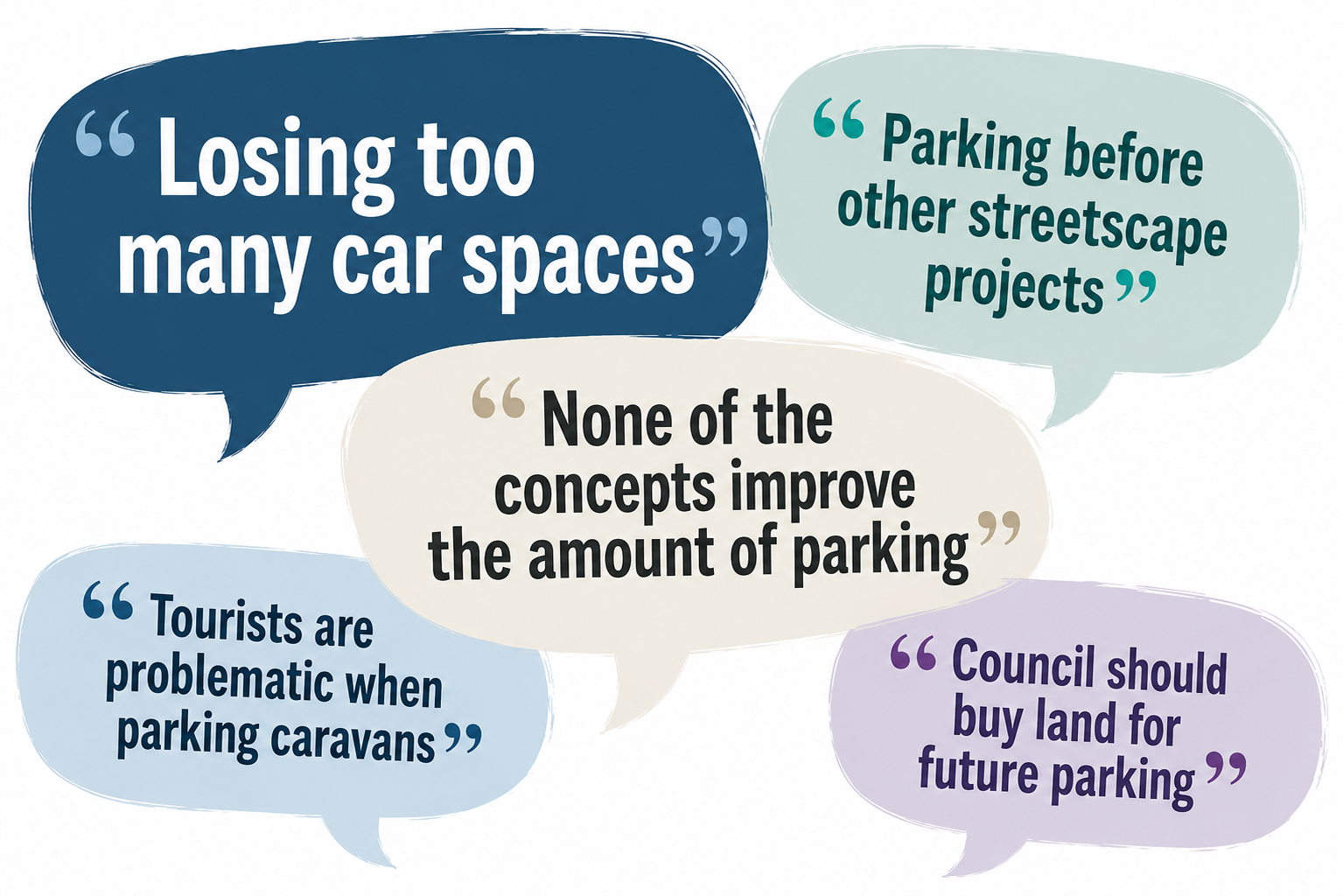
Community quotes / speech bubbles highlighting parking concerns
What communities actually support
When conversations move beyond that first layer a different set of priorities begins to surface.
The data also repeatedly reveals support for better walkability, slower traffic, gathering spaces, greening, shade, seating and more comfortable places to spend time - all core benefits of good urban design. Feedback also acknowledges common issues like underutilised rear parking and oversized road reserves, reminders that the parking conversation is often more complicated than it first appears.
What’s interesting is that these aspirations sit right alongside concerns about parking, even when the two aren’t always aligned.
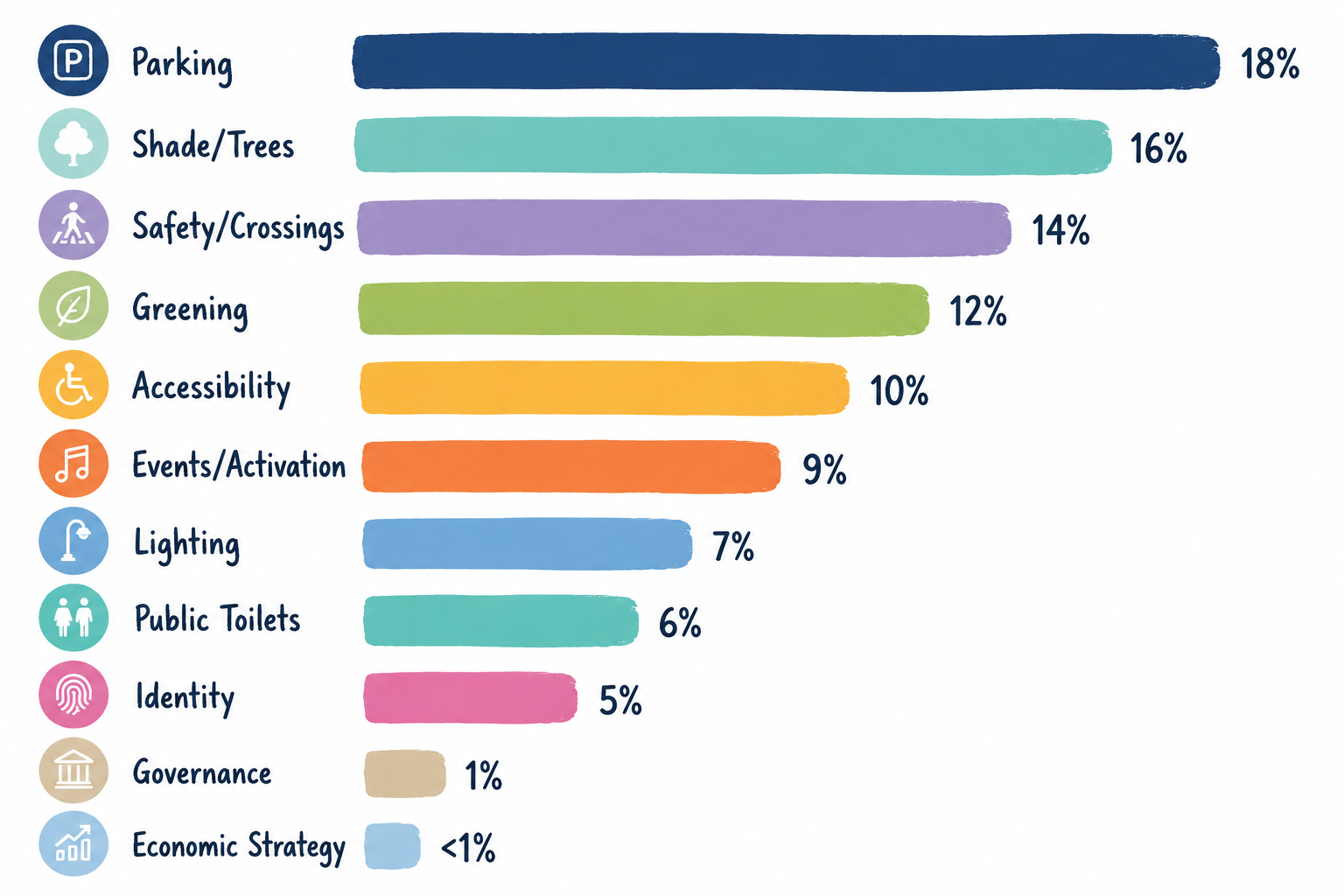
What Communities Consistently Tell Us
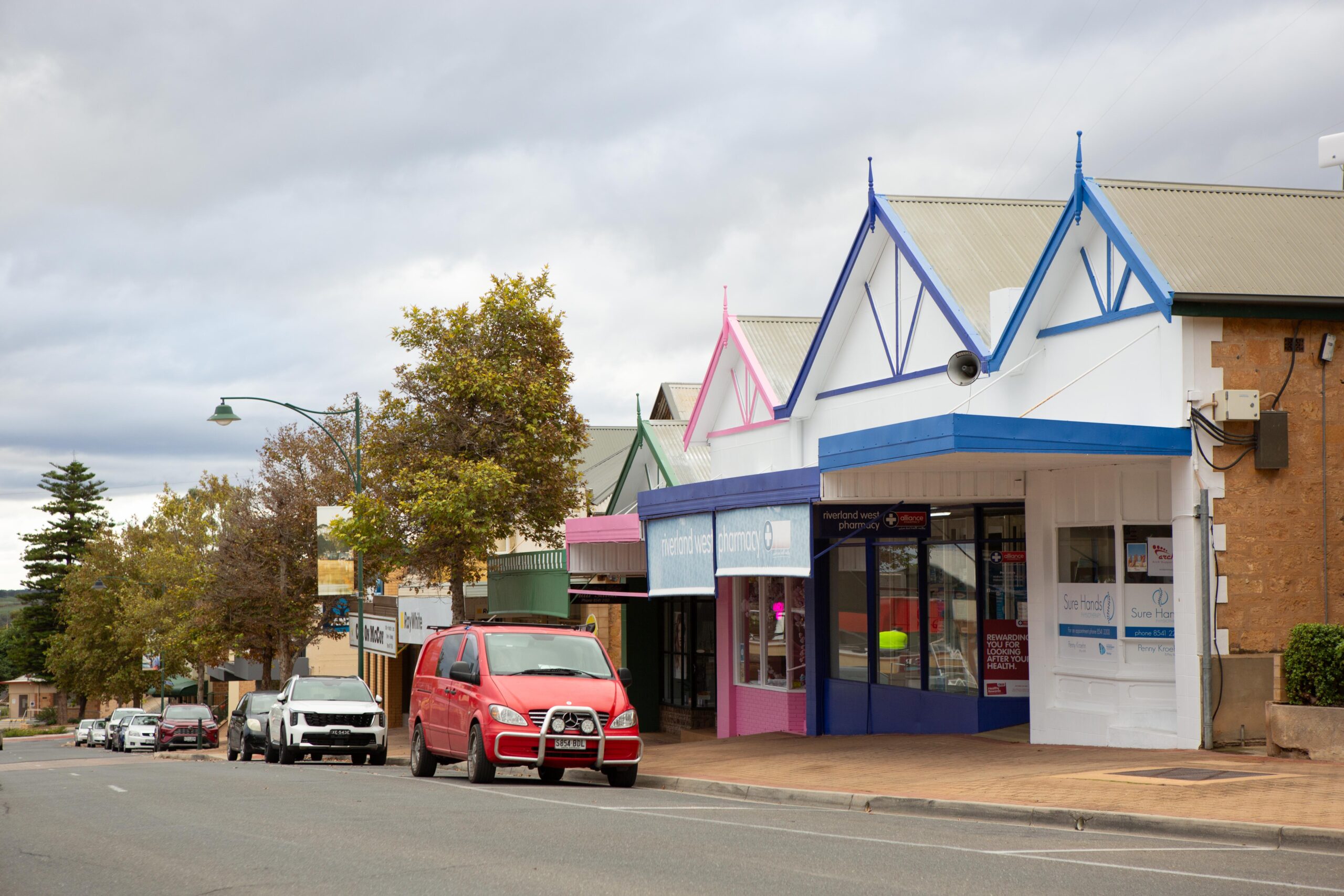
McCoy Street Waikerie
What we’re not talking about
But there was another pattern in the data that is harder to ignore. Across those same thousands of engagement comments, there are topics that are barely discussed at all. Not because they don’t matter, but because they sit outside the immediate, visible experience of the street.
Very little discussion directly addresses economic restructuring or demographic change, the influence of regional industries and employment, land and building ownership, business capability, governance, long-term management, investment attraction, retail transition or operational programming.
Perhaps we should not expect local communities to always be thinking about these things. But we as practitioners need to be.
Certainly at the Waikerie Forum these were often the factors highlighted to determine whether a main street can successfully adapt and thrive over time.
Projects are already delivering a lot
So what do our main street plans and designs over the past decade tend to focus on? Well in my experience main street projects already deliver a lot.
- Goodwood Road in Adelaide’s Inner South showed how side streets, public art and infrastructure upgrades can support local activity.
- Renmark’s Taylor Riverfront Precinct created a cooler, more attractive destination public space with shade, footpaths and crossings to the shops.
- Gumeracha in the Adelaide Hills introduced safer crossings, seating, trees, new footpaths, underground power and art through a strongly community-led process.
- At Glenelg, Chapel Plaza on Jetty Road brought new pedestrian and small events spaces, high quality public realm, lighting, toilets and art together at a detailed urban scale.
- Hamley Bridge supported property owners with shopfront improvements, lighting and targeted streetscape changes.
- At Two Wells we helped deliver a revived Village Green, toilets, footpaths and better main street integration.
More recently, projects in places such as Stanley, Tasmania; Todd Mall, Alice Springs; and Broken Hill Town Square have explored shared streets, heritage integration, increased shade in public places, tree planting, community space, art walks, outdoor dining and safer connections.
Different places, different scales, but a consistent set of ambitions: comfort, safety, access, amenity and community life.
So in many respects, main street planning and design is listening to community priorities. But the harder question is whether - in focusing on the visible and immediate issues - we are avoiding some of the deeper structural ones?
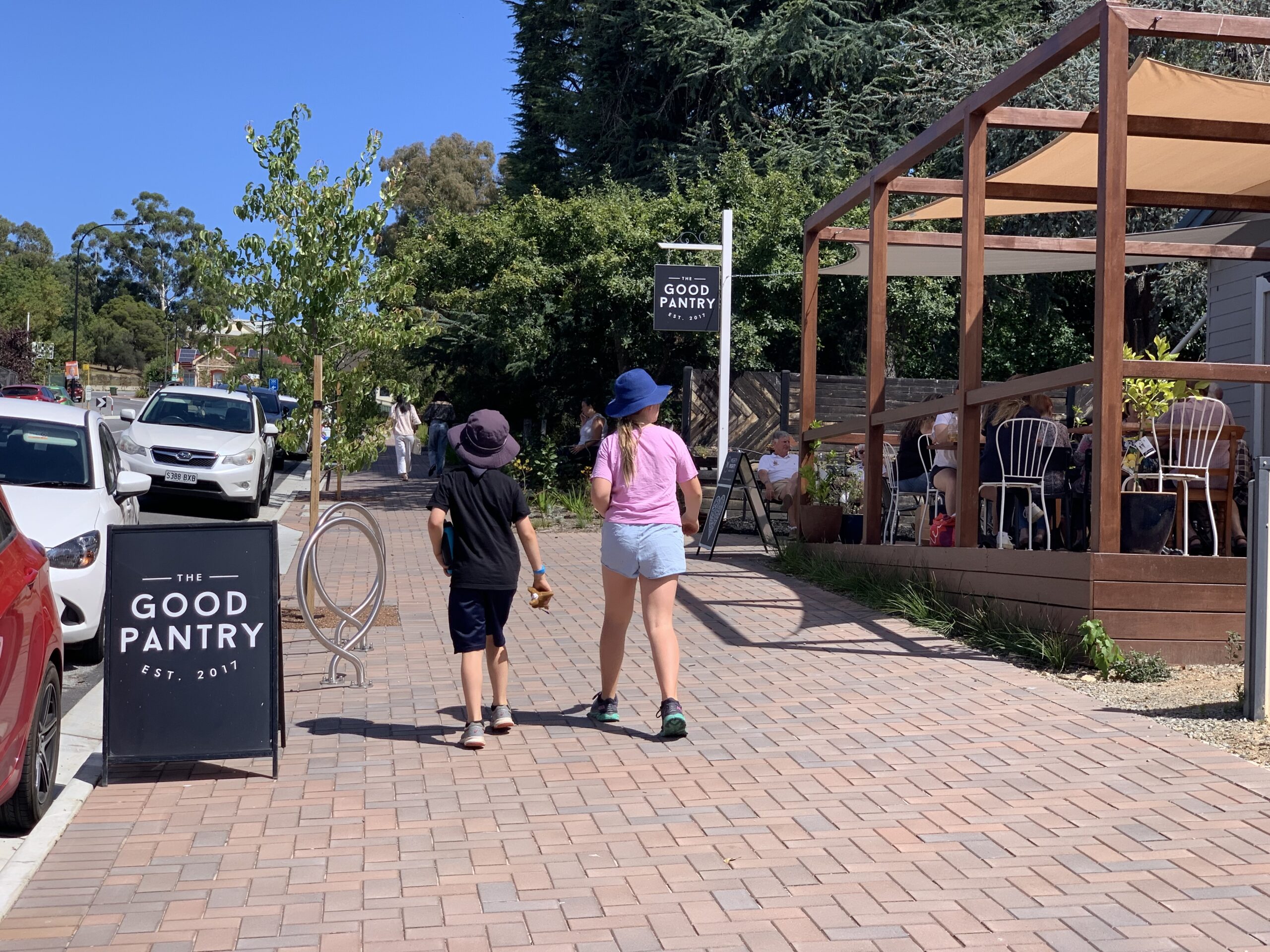
Gumeracha main street
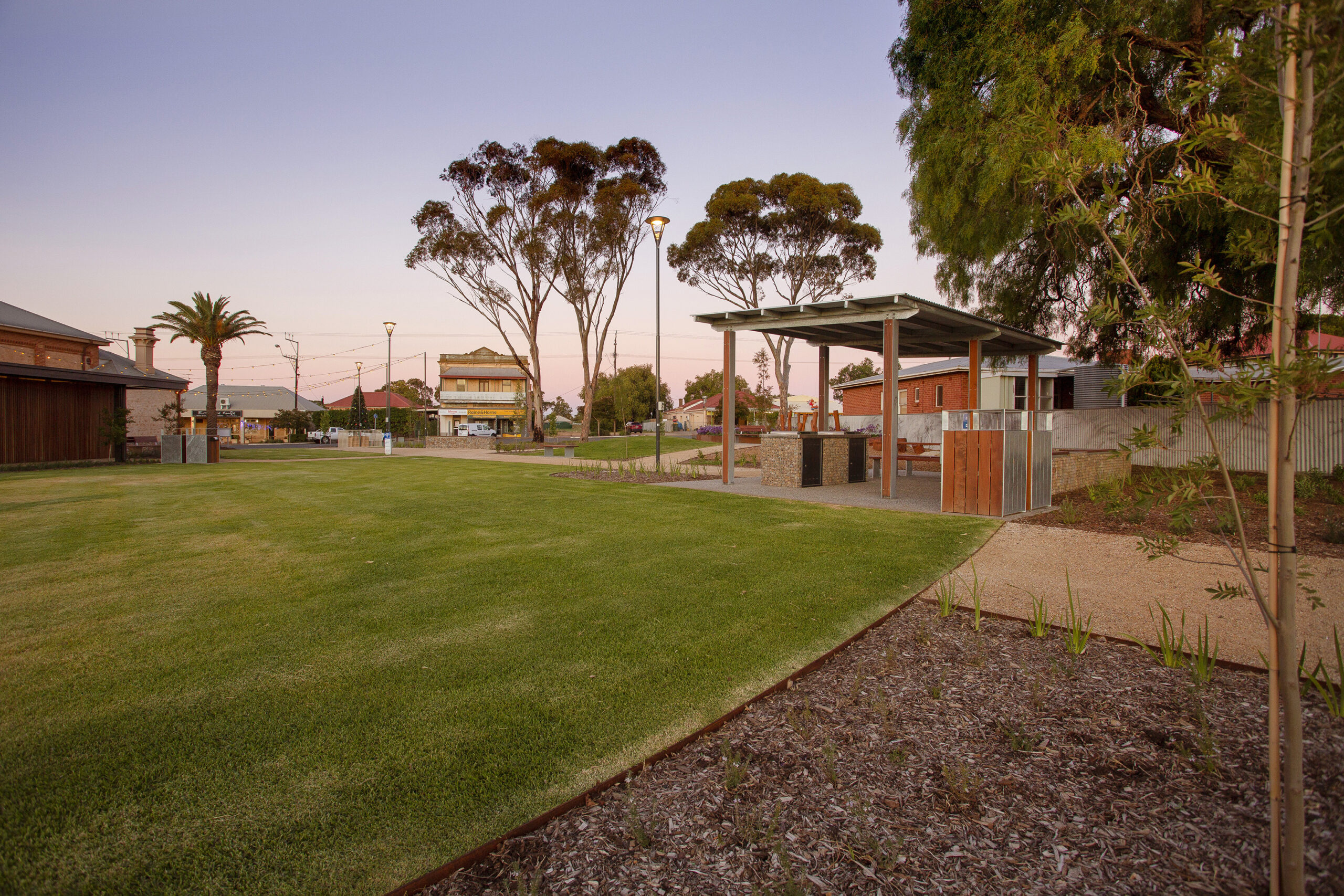
Two Wells Village Green
Symptoms and underlying causes
At the forum I tried to reframe some of the common concerns we hear, not as stand-alone problems, but as symptoms of something deeper.
Parking is often a symptom of access and movement problems. When parking dominates the conversation, it can point to deeper issues such as car dependence, weak walkability, poor connections from rear or side-street parking, and streets that still prioritise vehicle movement over comfortable pedestrian access.
The strategy is not simply to provide more parking, but to make the whole access system work better: clearer walking connections, safer crossings, slower traffic, better wayfinding, and more confidence that people can arrive - whether by car, e-bike, scooter or on foot – park, and comfortably move around the town centre. We heard at Waikerie how this can be achieved even in smaller regional towns.
Empty shops may be a symptom of economic and ownership challenges. Vacant premises can reflect changes in retail demand, online shopping, regional employment and population patterns, or in building condition or passive ownership.
Design can help make the street more attractive and usable, but it needs to be supported by strategies for business support, shopfront improvement, tenancy attraction, events, activation and stronger relationships between councils, property owners and traders.
High construction costs and limited funding are often symptoms of bigger delivery challenges. Many regional main street projects are affected by rising material and labour costs, small council budgets, competing priorities and the difficulty of securing enough funding to deliver a complete vision in one stage.
These challenges can make even well-supported projects feel hard to implement. The strategy is not to reduce ambition, but to be realistic about staging, partnerships and funding pathways.
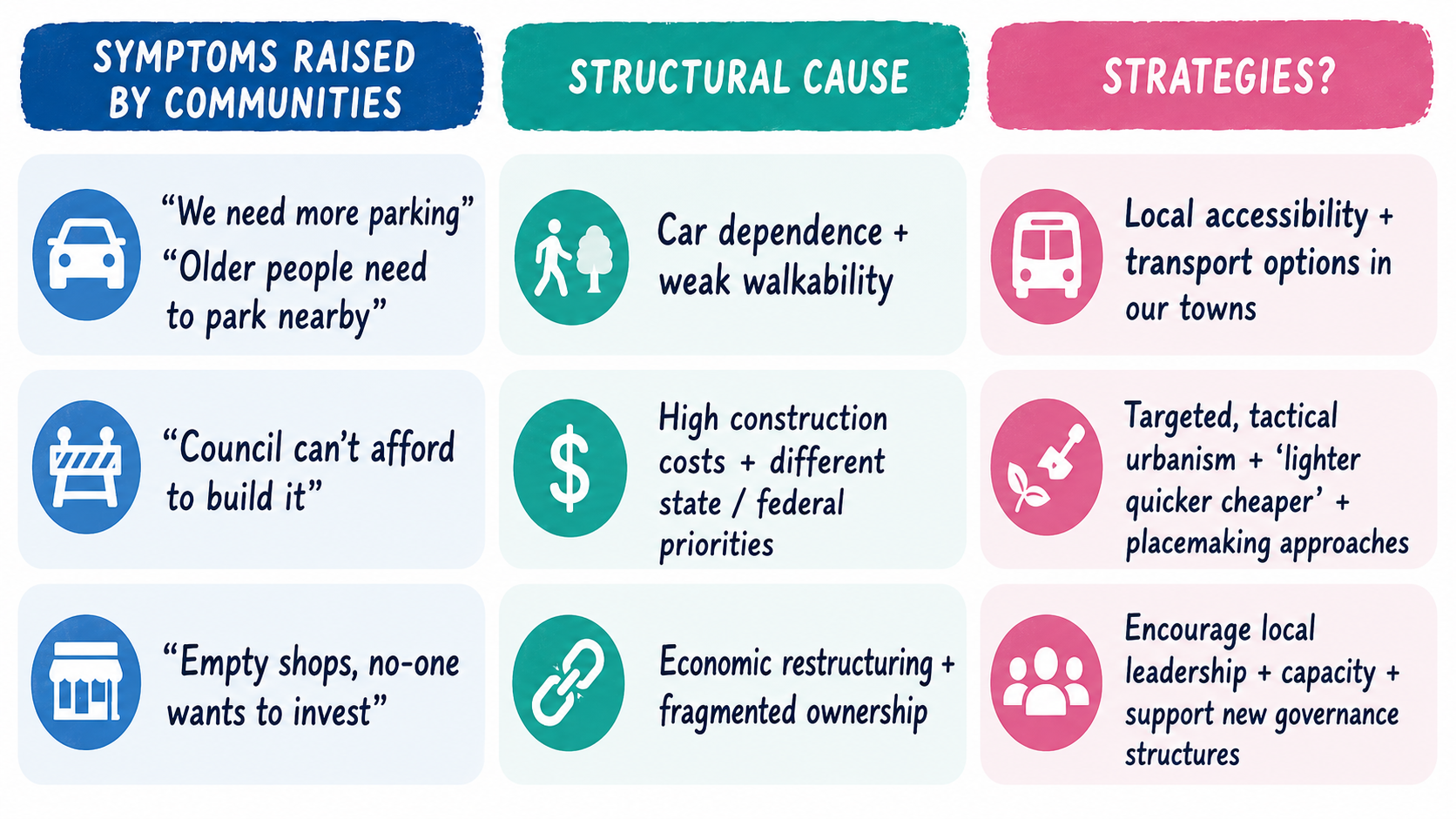
Regional Main Streets Face Real Structural Issues
A broader way of thinking about main streets
So the intent of the Waikerie presentation wasn’t to dismiss parking, or to suggest that it doesn’t matter. And in fact communities do have a broader perspective on what makes places work for them, for local businesses and for visitors.
Main streets and town centres are shaped as much by governance, investment and long-term stewardship as they are by kerb lines and materials palettes.
Above all, we need to stay committed to our main streets, because they remain some of the most important civic, social and economic places in regional communities.
They remain the centres of community life in many towns. The places people meet, connect, trade and spend time. And despite the challenges they face, there is still a strong expectation - and a strong appetite - for them to improve.
All of us need to keep listening to what communities are telling us, while also helping to gently expand the conversation.
If we can shift the focus, even slightly, we open up a much wider set of possibilities for what these places can become. Not ignoring parking — but being ready to move beyond it.
This article is adapted from a presentation delivered at the Regional Mainstreet Forum, Waikerie SA, 25 May 2026.